The NFL announced that it was granting $30 million to the National Institutes of Health to go towards the study of neurological diseases — coincidentally, Seau’s brain is currently being examined here (let the conspiracy theorist run wild). Obviously, this is a generous donation and the NFL should be applauded accordingly.
But, do notice the timing.
The NFL is trying to regain its image in the court of public opinion after taking several hits following the string of suicides; former players saying they won’t let their children play; and even worse, that the NFL’s about-face is insincere — primarily triggered by lawsuits.
The American Academy of Neurology released a study today, that was first reported by Jason Koebler of US News, which concludes, five year veterans are three times more likely to die from a neurological disease when compared to the general population.
The study confirms several allegations in the players’ lawsuits.
First, several former NFL players — Pete Duranko and Wally Hilgenberg, to name a few — were initially diagnosed with ALS. Now it appears, post-mortem, that they actually had the neurodegenerative disease, CTE. This likely suggests that several other deceased former players also had CTE.
Second, this study provides a glimpse of the reality behind the NFL and NFLPA’s touted statistic that players live longer than the general population. Though this may be true, it highlights that their quality of life is often much worse.
Third, and most importantly, football-induced brain trauma causes neurocognitive disorders. Or, at the very least, players are at an increased rate of dying from a neurological disorder. Although this study shows that there is a causal link between football and brain damage, the most significant challenge for the plaintiffs will be that the NFL proximately caused their brain damage, as opposed to the hits taken in college, high school and peewee – which may be impossible to prove.
Finally, this study and others may be helpful if the plaintiffs get to the stage of determining damages – i.e. calculating compensation. The study suggests that certain position players, such as special team wedge busters, are at a higher risk of having neurocognitive disorders, as opposed to “nonspeed positions” like linemen. However, studies from the Amen Clinic seem to refute this, as does Dr. Robert Cantu. Linemen are just as vulnerable to having neurodegenerative diseases due to the “repeated banging of the head day in and day out,” while in the trenches.
At the end of the day, and despite the posturing, the culture about concussions has changed for the better, whether it was spurned by lawsuits or by evolving science. We can only hope that the NFL will continue to enjoy, and bank roll, its self-proclaimed role as the leader of concussion awareness.
Click here to read the study: Neurodegenerative causes of death among retired National Football League Players
Former-player-turned lawyer is making it rain, and no, not in the strip club. After playing eight fairly successful years in the NFL, Mickey Washington pursued a law degree and now runs his own firm.
On Monday, he filed a concussion-related lawsuit against the NFL on behalf of 17 living players and 2 deceased players.[1] The lawsuit is led by 3-time Pro Bowler Larry Centers.
According to his firm’s website, Washington worked in a legal capacity at the National Football League Player’s Association where “he participated in negotiations over the NFL Collective Bargaining Agreements.”
This explains the clever pleading used by Washington in the complaint. The plaintiffs assert eight counts, the most notable being “conspiracy to defraud.” The plaintiffs allege that the NFL, member clubs, Mild Traumatic Brain Injury Committee and others conspired to conceal the long-term risks about repetitive concussive and sub-concussive blows. This is a standard allegation among the several lawsuits, but Washington artfully tries to shoot a hole in the NFL’s preemption argument.
The plaintiffs, here, allege the conspirators had three main goals. First, “to discourage talented players from retiring and to persuade all players to return to football games regardless of the concussions and brain trauma sustained.” Washington, as a former player, probably knows this first hand, but he, presumably, got out of the NFL before experiencing significant brain damage.
Second, drawing on his negotiating experience with the NFLPA, Washington writes and the plaintiffs allege, “[a]nother objective of the conspiracy was to prevent persons bargaining on behalf of players to have sufficient knowledge to demand that policies, procedures, and conditions be included in the CBAs and other contracts that were sufficient for the protection of players in connection with brain trauma and concussions.”
In other words, but for the NFL misrepresenting to the players that there wasn’t a link between concussions and brain damage (i.e. dementia, CTE, etc.), then the NFLPA would have negotiated for increased cognitive benefits or sought to implement these prior to the most recent CBA — which does provide for benefits under the 88 Plan.
Although this partially addresses a question I posed in my interview with Forbes, it still has potential holes. For example, the NFLPA had — or reasonably should have had — independent studies at their disposal, linking concussions to long-term cognitive decline, and they could have brought these studies to the bargaining table.
Nonetheless, Washington’s argument may show that the prior CBAs are a product of fraud, and thus cannot be used to bar the players’ lawsuits. Whether concussions and brain damage were even discussed at the bargaining table, and therefore had a material effect on the negotiations is unknown, but it will certainly be discovered once, and if, the plaintiffs get to the discovery stage of litigation.
Finally, the third objective of the co-conspirators strikes at the heart of the NFL’s motion to dismiss, “which was to deprive players of their right to seek damages for concussion-related injuries in court by using the Collective Bargaining Agreements as a purported future bar to any civil court action by players,” according to the complaint.
Whether this strategic pleading will be sufficient to overcome the NFL’s motion to dismiss will ultimately have to be decided by Judge Brody. Washington foreshadows some of the arguments that the plaintiffs will use once they respond to the NFL’s motion to dismiss
On a final note, it is remarkable to see how many former NFL players went on to get a law degree after the game. Some of them are suing the NFL, such as prominent sports agent Ralph Cindrich and Brad Culpepper. Others, like Washington, Bob Stein and Hall of Famer Ron Mix are advocating on behalf of former players while having successful careers as lawyers. Lastly, don’t forget about the Honorable Alan Page, who sits on Minnesota’s Supreme Court, and the late Byron “Whizzer” White who sat on the “highest court in the land.”
[1] Washington is not a plaintiff, and the two deceased players are Johnny Bailey and Johnny Lewis.
It has been one year since Derek Sheely died after suffering a traumatic brain injury during football practice. His family is carrying on his legacy through the Derek Sheely Foundation.
Unfortunately, the NCAA has failed to investigate the events surrounding the death of Derek. The NCAA appears to be more concerned about preventing student athletes from having dinner with Deion Sanders, than ensuring corrective measures are taken so another player isn’t killed on the gridiron. The NCAA is a multi-million dollar cash cow that has an opportunity to shine a light on concussion awareness; instead it sits idly behind its governmental structure and says that it doesn’t have the authority to investigate the accident.
What follows is correspondence between Derek’s mother and the NCAA. As you will see, Mrs. Sheely pleads with the NCAA to step up and investigate; yet the NCAA responds with mere lip service.
December 30, 2011
Mark Emmert
NCAA
700 West Washington Street
PO Box 6222
Indianapolis, IN 46206-6222
As you know there is a growing concern about concussions in sports. What you may not know is that there are an estimated four million sports-related concussions each year. This is one concussion every 8 seconds! All concussions are serious because they are traumatic brain injuries and most occur without the person being knocked unconscious. Concussions happen in every sport, with young children playing hockey, football, soccer, basketball, wrestling, baseball, and cycling at the highest risk. There are far too many concussions but far too few programs educating parents, athletes, and coaches to the dangers, signs, symptoms, and prevention of these traumatic brain injuries. There is even less attention being paid to critical research that could minimize, diagnose, and treat brain injuries.
THE DEREK SHEELY FOUNDATION was created to increase awareness and research of concussions and traumatic brain injuries, with a focus on youth sports. The Foundation is named in honor of my beloved son, Derek Thomson Sheely, a strong and healthy 22-year-old honor student who played fullback for ten years. Derek was a two-time academic all-conference selection in college and never had a documented concussion. On August 22, 2011, during practice for his senior season at Frostburg State University (an NCAA Division III school), Derek suffered a brain injury and died one week later on August 28. It is believed that Derek died from Second Impact Syndrome, which occurs when a second concussion is sustained before the brain can recover from a first concussion. As Derek’s mother and the Executive Director of The Derek Sheely Foundation, I am dedicated to preventing other children and families from suffering through the devastating effects of concussions and brain injuries.
THE DEREK SHEELY FOUNDATION is committed to “Leading the Way” towards concussion and brain injury awareness and research. We often think about the level of medical support available to NCAA Division I football players and professional athletes during games, however, the vast majority of the nearly 4 million concussions that occur each year happen at youth sporting events where there are no medical professionals available, where the athletes are young children and the coaches are parents. In these cases, education aimed at young children and their parents could prevent hundreds of thousands of concussions per year from becoming more severe.
As you know, sports-related concussions and brain injuries are not something that can be solved quickly with a simple fix; rather, they are a national epidemic, requiring years of educating athletes while they are young to the signs, symptoms, and precautions. While helmet and protective gear technology is important, there never will be a concussion-proof helmet because they can never prevent the brain from hitting the skull. Therefore, The Derek Sheely Foundation has a unique goal as compared to other concussion organizations. That goal is to lead an initiative to educate young children, with a focus on ages 7-14, to what a concussion feels like, what you should do when you think you have a concussion, why reporting a concussion ASAP is important, and what can you do to avoid/minimize getting/giving a concussion. If we can break the stigma about athletes self-reporting concussions in these 7-14 year-olds now, then within a decade when these kids go on to play in high school and college, the concussion epidemic we are facing now could be greatly reduced. I know you are concerned about concussions and I know you have taken steps to help NCAA athletes, but I am asking for your help to use your power and resources to help me and The Derek Sheely Foundation extend concussion awareness and prevention to the millions of young athletes (sons, daughters, grandchildren, and great-grandchildren) playing and enjoying sports every day.
My son Derek was passionate about football and we are not looking to change the game. Derek may not have had the skills to play in NCAA Division I, but he did have the heart and dedication of an NCAA Division I athlete. One of Derek’s favorite sayings listed on his Facebook page is, “Some men see things as they are and say ‘Why?’ I dream of things that never were and say, ‘Why Not?’” It is with this spirit that The Derek Sheely Foundation has begun a campaign to raise $40 million to increase awareness and research of concussions and brain injuries (Derek wore number 40). We need the NCAA to partner with us to achieve this dream.
THE DEREK SHEELY FOUNDATION is open to many different partnering arrangements with the NCAA. I have listed several ideas below, but please feel free to edit or add to them. We could start small with one and build on our successes, or choose two or three that are most practical. Potential partnering arrangements:
- Awareness Campaigns
- Case Study on Derek’s Accident: The Derek Sheely Foundation is conducting a Case Study of Derek’s accident to determine lessons to help other children in the future. It was surprising to learn that the NCAA was not funding this Case Study, since Derek died from an injury caused during an NCAA sanctioned football practice. The NCAA can support and help fund our Case Study.
- Concussion Prevention Hero: We can break the negative stigma with reporting concussions by rewarding young athletes who report a concussion in themselves or with a teammate. Prizes could be jerseys, tickets to see their favorite NCAA team, etc. Maybe NCAA Conferences/Schools could nominate one hero a year from their area for a special national heroes event at a conference football championship game or a BCS Bowl game. Much like the success with reducing breast cancer deaths over the past 40 years, the first key is education and self-reporting, and so we need to publicly break the stigma. No one can achieve this goal as well as the NCAA and its schools.
- Public Service Announcements: Short 15-60 second You Tube, Facebook, Twitter style announcements given by famous NCAA coaches or players in a format today’s youth can absorb.
- NCAA Sponsors: Many NCAA sponsors (e.g., Like Nike, Under Armour, ESPN, Coke, Pepsi, computer companies, phones, etc.) target the same 7-14 year old audience. The NCAA could reach out to these sponsors to get the message out and provide awards for the Heroes or funds for the awareness campaign.
- Fundraising for The Derek Sheely Foundation
- NCAA donations, whether checks or donated merchandise like BCS Tickets can help raise funds for awareness kits
- NCAA Schools having coin boxes at games for donations – Make a Change with Your Change
- NCAA press release noting support for The Derek Sheely Foundation and adding links to the Foundation on your websites, Facebook pages, and Twitter would greatly help
Thank you so much for taking the time to consider The Derek Sheely Foundation. I hope you can help us prevent concussion and traumatic brain injuries from affecting children, and your generous and tax-deductible donation[1] can help us achieve our shared mission. Checks payable to “The Derek Sheely Foundation” can be sent to 14001 Falconcrest Road, Germantown, MD 20874. On-line donations can be made at our website, http://www.TheDerekSheelyFoundation.org. Please visit our website and follow us on Facebook and Twitter. You can reach me directly at info@TheDerekSheelyFoundation.org.
Kristen L. Sheely
Executive Director
________________________________________________________________________
The NCAA’s Response

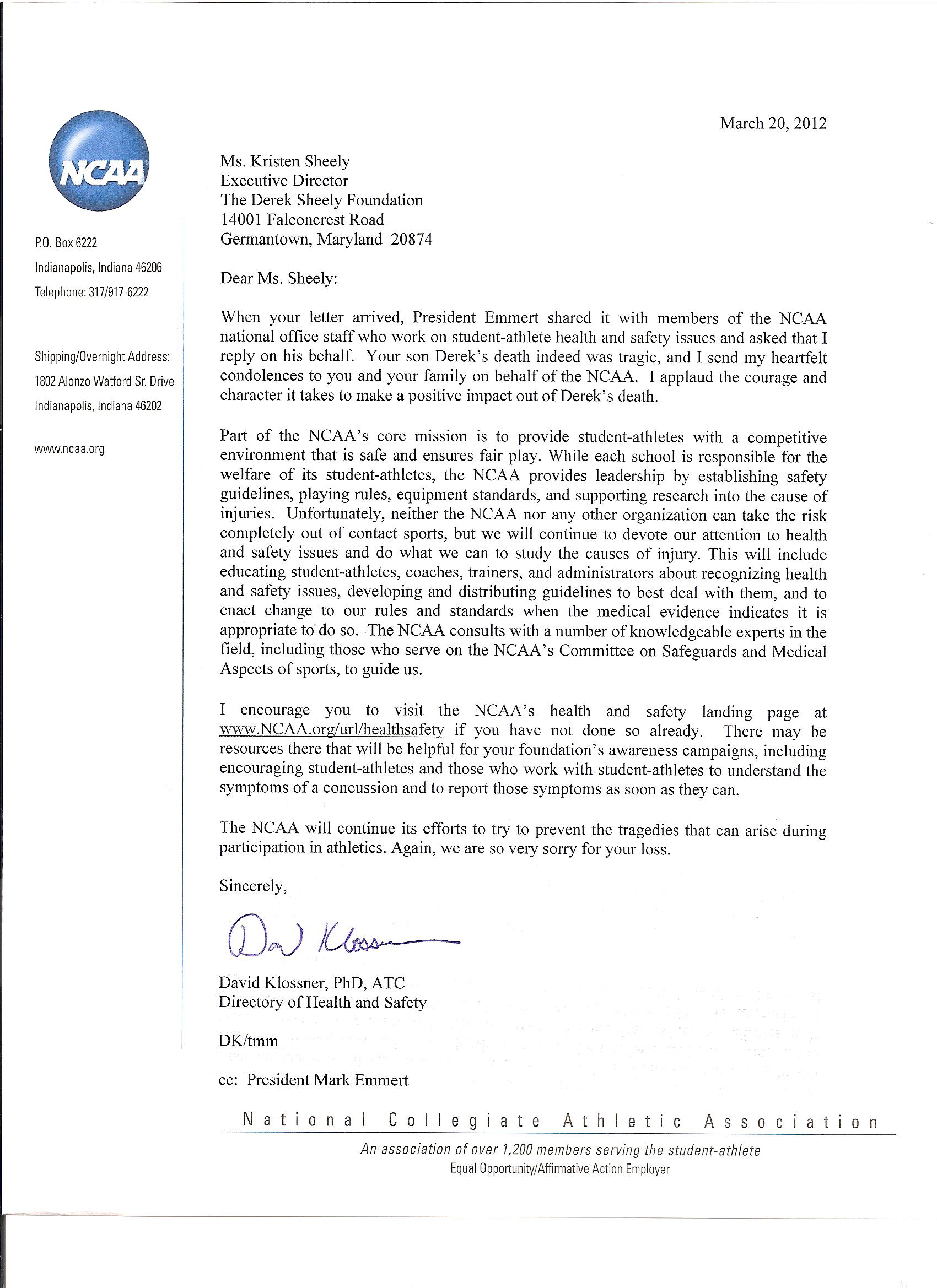
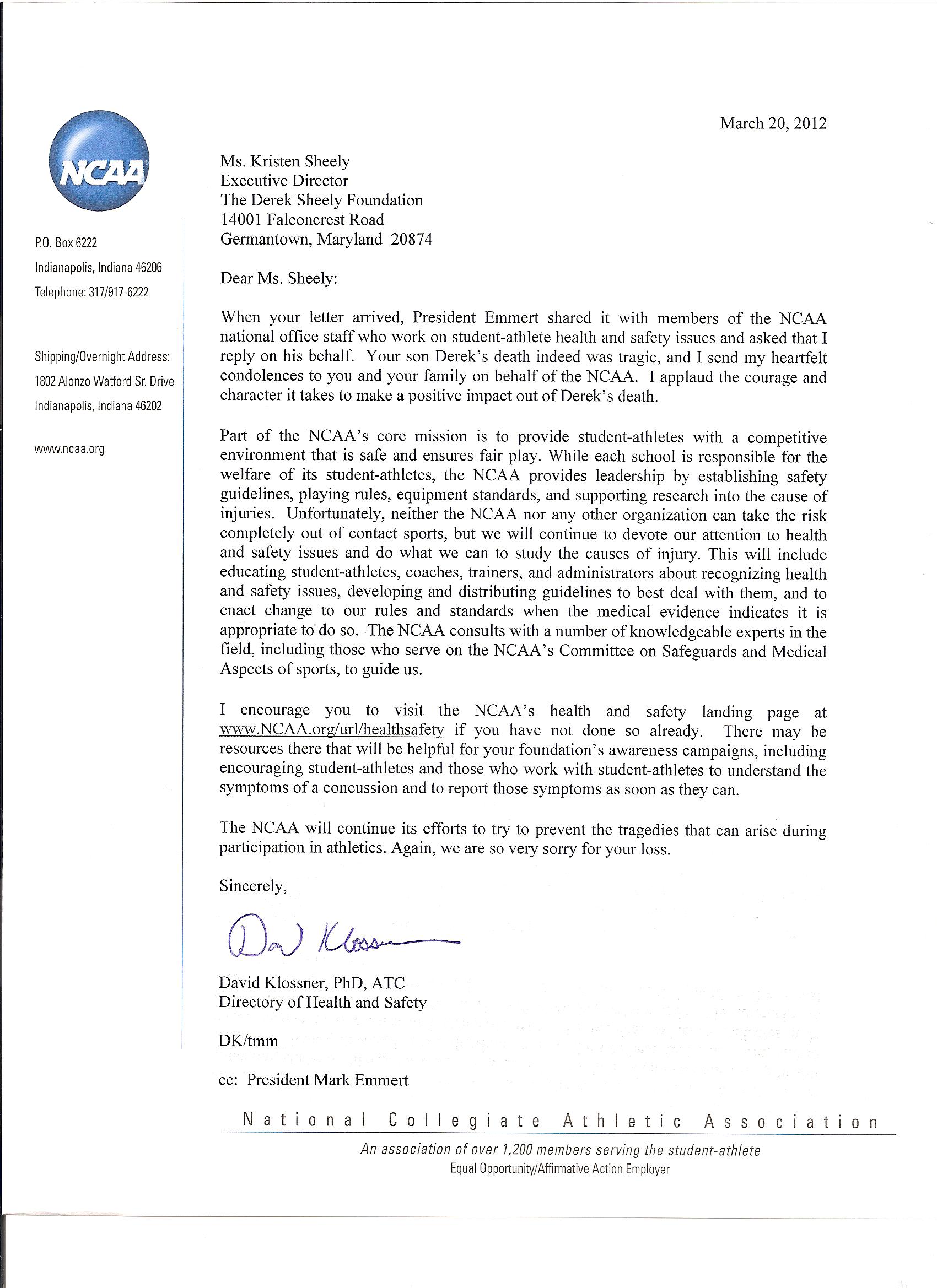
[1] THE DEREK SHEELY FOUNDATION is a community outreach program of Prince of Peace Lutheran Church, a 501(c)(3) nonprofit organization.
Can a helmet, mouth guard, helmet shell, or other sporting equipment prevent or reduce concussions? Absolutely not! Whenever sufficient forces are transmitted to the brain–via a hit to the head or body–nothing can prevent the brain from slamming against the skull.
Unfortunately, companies are taking advantage of the concussion crisis by marketing their products as having the capability to reduce or prevent concussions.
The Federal Trade Commission (FTC) recently slapped Brain-Pad with an administrative complaint for violating Section 5(a) of the FTC Act. The FTC found that Brain-Pad’s marketing was false and misleading.
Some examples of the marketing used by Brain-Pad consisted of the following:
- “Reduces risk of CONCUSSIONS!”
- “Reduces the risk of concussion from: facemask impact, chin cup forces & direct lower jaw impact.”
- “Creates new brain safety space!”
- “Tested and proven to reduce risk of internal head injuries and concussion from lower jaw impacts”
- “BIOMECHANICALLY TESTED & PROVEN.”
- YouTube: “Brain Pad Protective and Performance Mouth Guards”
Brain-Pad and its President, Joseph Manzo, entered into a proposed consent order with the FTC, which will require Brain-Pad to cease making unsubstantiated claims that the mouth guards can prevent or reduce concussions. Once the order becomes final, and if Brain-Pad continues to make false claims, it will be hit with monetary fines of up to $11,000 for each violation.
Although this is a step in the right direction, other companies continue to make similar claims. Furthermore, the settlement does not provide a remedy to the consumers that were injured by Brain-Pad’s false and misleading conduct.
Probably the most outlandish example of false claims comes from MaherCor Laboratories, LLC.[1] MaherCor provides an expensive, moldable orthotic-type mouth guard allegedly designed as “an aid in the prevention of concussion.”
Aids in Concussion Prevention To help reduce the chances of suffering from a concussion, it is important to always wear a Maher product while participating in sports. The implementation of this properly-fitted mouth guard with the prescribed thickness separates the mandible (lower jaw) from the maxilla (upper jaw). This limits the chance of obtaining a concussion via a direct blow to the jaw. This, as well as wearing properly fitted protective head gear and chin straps allows for the utmost protection from dangerous head trauma. Mahercorlabs.com/concussions
John Gonoude had a promising athletic future entering into his freshman year of high school football. He was the captain of the squad, and his peers looked up to him as the next leader to take his team to the state championship.
Tragically, numerous concussions sidelined John’s football dreams.
During the summer of his sophomore year, a new coaching staff was put in place and John’s goal was to show the coaches he deserved a spot on the varsity squad. He suffered his first concussion during training camp and was required to sit out for a week.
In the interim, John’s father explicitly told his coach not to allow him to return to practice until a medical professional cleared him to play.
John believed he had to get back on the field or else he would lose his shot at making the varsity squad. Despite his father’s directive, the coach allowed him to return to play.
Later that day during line drills, John said he felt “like his brain was creeping out of his skull,” and he began screaming in pain on the ground. After his father shared a few choice words with the coach, his family decided it would be best if John sat out for the remainder of the season.
John experienced constant headaches, he couldn’t bear bright lights, and he had trouble reading — symptoms of post-concussion syndrome — which, according to John, made him “scared as hell.”
He and his father began researching concussions and looking for equipment that would allow him to return to play. His father came across the MaherCor website which promised a quick fix to prevent concussions. In fact, numerous professional athletes endorsed Maher’s mouth guard as effectively preventing concussions.
I previously had 3 concussions. I started wearing The Maher Mouth Guard 3 years ago and have not had a concussion since. I feel very comfortable wearing The Maher Mouth Guard and recommend it for any contact sport. It is perfect! Asante Samuel[2]
John said he and his dad were entirely convinced the mouth guard would keep him concussion free. His father dropped a coupled hundred dollars so that his son could be properly fitted with the Maher B-Protect Splint.
John was ecstatic. He told his friends and coaches that he was fitted with a mouth guard that would prevent concussions.
Cloaked with a shield of security, John felt that he could hit harder because he was protected with the mouth guard.
During the first week of training camp, prior to his junior year, John took another blow to his head, causing his third concussion. This time, ending his hopes of ever playing tackle football again.
John said other than giving him “a false sense of confidence,” the mouth guard was utterly worthless. “I wish people didn’t have to deal with this; especially once consumers find out the investment backfires.”
Leading neurologists and experts on sport-related concussions agree.
Dr. Jeffrey Kutcher, American Academy of Neurology’s chairman of sports neurology, testified that, “The simple truth is that no current helmet, mouth guard, headband, or other piece of equipment can significantly prevent concussions from occurring…Concussion prevention is much more about teaching proper technique, playing by the rules, and limiting the overall dose of impacts.”
Boston University’s team of experts, Dr. Cantu, Dr. Ann McKee, and Chris Nowinski, recently did a study of “concussion prevention devices.” The conclusion: “there is currently no evidence that standard or fitted mouth guards decrease the rate or severity of concussions in athletes.” Further, there was “no statistically significant results” to show that the custom mouth guard, which can cost up to $600, was any more effective at preventing or reducing concussions than a standard $5 boil-and-bite mouth guard.
Additional studies concur and conclude that the studies performed by Dr. Maher are flawed in multiple respects because they were based on “limited case series studies and retrospective, nonrandomnized, cross-sectional surveys.”
Though John still battles the cognitive effects of concussions, he has become a beacon for concussion awareness and frequently contributes to The Concussion Blog. John’s goal is to educate others about the severity of concussions, and that it’s ok to sit out if you are still showing signs of concussions.
There is no question the mouth guard negatively affected John, “As much as I love football, football scares the living hell out of me.” And John warns, “The fact that we have companies profiting and perpetuating the concussion crisis, sickens me.”
One of the main principles of concussion awareness is ensuring coaches, athletes and parents are educated about the symptoms of concussions. The false sense of security that the mouth guards, and other “concussion prevention” devices, provide undercuts this. An athlete who believes his equipment can prevent concussions is much less likely to report symptoms, dismissing them as a regular headache. Likewise, a coach and parent will put their guard down because they believe the athlete is less susceptible to concussions.
At bottom, MaherCor and other companies should not convey false messages that their product can effectively reduce or prevent concussions. Manufacturers would be wise to take note of the FTC’s recent actions and change their marketing schemes, or else they will be sued for violating consumer protection statutes.
If you have purchased any of the following products – Brain-Pad, Maher Mouth Guard, Guardian Caps, Full90, Shock Strips, etc. – please send me an email, at PaulD_Anderson@me.com, expressing your thoughts on the products effectiveness.
[1] The founder of MaherCor is also the New England Patriots’ dentist.
[2] Dustin Fink at The Concussion Blog scrutinized this comment and several other claims made by MaherCor and its employees. http://theconcussionblog.com/2011/09/30/mouth-gear-comments/#more-4775
Updated 9-16-2012:
As first reported by NFLConcussionLitigation.com, the NFL was sued by Alterra American Insurance on Monday seeking a declaration that it does not have a duty to defend or indemnify the NFL in the ongoing concussion lawsuits. Now the plot has thickened.
The NFL has sued 32 — it is mere happenstance that the number of defendant-insurers coincides with the number of NFL teams — of its former insurers for allegedly breaching their duty to defend against the concussion lawsuits.
The NFL says it has paid “millions of dollars in premiums” and now the insurers are saying no dice.
According to the NFL, “the insurers issuing such policies have failed and refused to discharge their obligations to defend the NFL and NFL Properties in the injury lawsuits…and breached their duty to defend.”
The various comprehensive general liability insurance policies were in effect from March 4, 1968 through August 1, 2012, all of which were in effect at different times. (For example, Fireman’s Fund was in effect from September 20, 1976 to October 20, 1977, Century Indemnity was in effect from March 4, 1968 to December 18, 1968, Illinois Union Insurance Co. was in effect from November 20, 2002 to August 1, 2006, etc.)
The dispute centers on when the duty to defend was triggered. The policies are so-called “occurrence policies” and the duty to defend is triggered, according to the NFL, when “the occurrence leading to the liability resulted in injury during the Policy’s policy period.”
In other words, the NFL is arguing the alleged injuries suffered by the 3,000+ former player-plaintiffs occurred when the various policies were in place. The insurerers, on the other hand, will likely argue that the duty to defend was not triggered until well after the policies were no longer in effect, presumably when the NFL’s alleged wrongful conduct occurred or when the first concussion lawsuit was filed in July 2011.
The case is National Football League and NFL Properties v. Fireman’s Fund Insurance Co. et al, filed in Superior Court of California – LA. (Sorry for the short analysis, I’m on vacation!)
The NFL will have to endure yet another legal battle. This time, though, the lawsuit was filed by the NFL’s own insurer, Alterra American Insurance Company.
On Monday, Alterra American Insurance Company filed a declaratory action against the NFL claiming (1) that it does not have a duty to defend the NFL in the concussion lawsuits and (2) that it does not have a duty to indemnify if a judgment is rendered against the NFL.
A declaratory action seeks a determination by the court regarding the respective rights and duties of the parties. In essence, the court will be required to interpret the insurance policy that was issued by Alterra.
According to Alterra, it issued an “excess casualty” policy to the NFL, which was effective from August 1, 2011 to August 1, 2012. The NFL tendered nearly all the pending concussion lawsuits to Alterra requesting that it defend and indemnify. According to the complaint, Alterra declined coverage to the NFL.
Alterra claims that it neither has a duty to defend nor to indemnify.
This is not the first insurance dispute. In May, Riddell Helmets filed a lawsuit against several of its insurers because the insurers also claimed they did not have a duty to defend or indemnify against the concussion lawsuits.
This could signal that Alterra sees the concussion litigation as being a major expense to defend, with an additional threat that it will be required to fork out millions, or perhaps billions, if a judgment is rendered in the former players’ favor. On the other hand, this is also what insurance companies do best: avoid and/or deny payments.
In either event, it is now up to the court to decide whether Alterra will be required to defend the NFL in the concussion lawsuits.
The case is Alterra American Insurance Company v. National Football League, filed in the Supreme Court of New York, New York County. The complaint can be accessed here: Alterra v. NFL.
With football season just around the corner, the proliferation of concussion talk will surely weigh heavily on sports writer’s fingers. So, I’ll weigh in on a few of the more intriguing articles. Here go.
George Will Opines on the Concussion Crisis
George Will is the leading conservative columnist, with views, which at times, go against the pompoms of the Obama Administration. He also holds a prominent position in baseball, sitting on Major League Baseball’s Competition Committee.
So when ole’ George speaks, people should listen.
He argues that the increased violence of the game is not because of the lack of rules; rather, it’s the players who are getting bigger, faster, stronger, and the human body is genetically incapable of adapting to the “game’s kinetic energies.”
The NFL’s problem, according to Will, is not so much the lawsuits, but the gladiatorial-thrill of watching the spectacle of the player’s brain being destroyed with each concussive and sub-concussive blow.
For those that are aware of the anatomical forces that are at play with each hit, the game has taken on a new visual imagery. The way I watch the game has changed dramatically, with each blow — whether it is the lineman in the trenches or the receiver getting slammed over the middle — I picture the brain rattling around the skull, like Jell-O in a glass jar.
As a member of the MLB Rule Committee, Will says, “the problem is not the rules; it is the fiction that football can be fixed and still resemble the game fans relish.”
So take solace my NFL and CFB fans, the “most powerful journalist in America” agrees: the inherent violence of the game cannot be changed.
Though rule changes will be effective at the peewee to high school level, the NFL would be wise to take the conservative, hands-off approach, if it wants to remain the most watched sport in America.
Another Hall of Famer Will Join the Concussion Litigation Battle
Richard Dent recently told the Chicago Sun-Times that he intends to file a lawsuit against the NFL. “I think it’d be nice if all the players could go up under one and represent all the players.”
This, of course, doesn’t come as a surprise and exemplifies why more recognizable players will likely be joining the concussion lawsuits. These guys have played a team sport all their lives and some see this as one last fight to get “their little piece [of the NFL’s multi-billion dollar] pie.” Moreover, former players see their brothers suffering from degenerative brain disease, though some aren’t currently facing cognitive disorders, a growing majority fear they might be staring down the barrel of a Colt .45 some day.
So, why not try to cash that final check? The players would be wise to stick to the talking point that this is not about a “money grab.” They will have a tough time convincing a jury — who probably made a quarter of the life earnings the players have — that they deserve more money. Rather, it should be about ensuring they are provided with lifetime cognitive treatment.
Another common theme among former players is a potential emerging figure in the concussion lawsuits: the team physicians. Dent told the Sun-Times, “You look at your report, and you don’t see certain information, like meds that were given to you,” he said. “But you remember. Teams pass out [meds] and pass beer out, too.”
This is no secret. Several former players have written about the beer and pills being passed around on the plane rides home. And, it’s also no secret that the doctor-patient relationship is often a conflicted one.
However, none of the recent concussion-related lawsuits – at least yet – has targeted a team doctor, save the members of the Mild Traumatic Brain Injury Committee. Many former players I have spoken to often ask, “Why aren’t the doctors and trainers being sued? They were the ones that told me I could return to play after I answered the three common questions, who, what and where.”
The plaintiffs’ lawyers’ current theory is that the NFL was the mastermind that created “junk science” and failed to implement adequate return-to-play guidelines. In other words, the NFL dictated how the teams, doctors, and trainers would handle concussions.
Whether the plaintiffs’ lawyers’ theory should be tweaked to add the teams and team doctors is a route that some litigants should be discussing. Once, and if, a team doctor is discovered to have played a role in the alleged concealment about the risks of concussions, you can bet he’ll be added to the growing list of defendants.
According to the Tampa Bay Times, Tennessee Titans Wide Receiver, O.J. Murdock, has died of an apparent suicide. Murdock was only twenty-five-years old.
Murdock was found inside his car with a self-inflicted gunshot wound and was later pronounced dead at the hospital.
Murdock played one season in the NFL but spent the entirety of it on injured reserve, and he did not report for training camp this year due to “personal reasons.”
This suicide comes on the heals of the NFL announcing its Health and Wellness program aimed at safeguarding and protecting players who are suffering with mental-health problems. The League provides an NFL Life Line which players and their families are encouraged to call if a person is suspected of having mental-health concerns.
It’s obviously too early to speculate that head trauma was a contributing factor in Murdock’s death. However, there is no question that Murdock — like any other high school, college or professional football player — experienced repeated sub-concussive hits throughout his playing career.
Several former NFL players have committed suicide in the past eight years: Ray Easterling, Junior Seau, Dave Duerson, Michael Current, Shane Dronett, Terry Long and Andre Waters. Several other former players died in perplexing ways, but they were not ruled a suicide: John Grimsley, Curtis Whitley, Mike Webster, Tom McHale, and Justin Strzelczyk. At least nine of the twelve were diagnosed with Chronic Traumatic Encephalopathy (CTE).
Last month, a “unique” concussion lawsuit was filed against the NFL, which named several Clubs as a defendant.
The lawsuit, initially filed in state court in Hillsborough County, targeted six teams and, evidently, a cheerleading squad. According to the NFL, the plaintiffs sued the wrong party in their attempt to name the Tennessee Titans. Instead of suing the NFL franchise, the plaintiffs sued the Tennessee Titans Entertainment Inc., which solely employs the cheerleaders.
Despite this screw up by the plaintiffs’ lawyers, they will probably amend their complaint by dismissing the cheerleaders and adding the property entity, Tennessee Football Inc.
In addition to this perfunctory error, the plaintiffs’ lawyers also failed to communicate with their client, Jimmie Giles. Giles was already a named plaintiff in one of the first concussion lawsuits, Barnes v. NFL. In fact, his lawsuit is currently pending in Philadelphia, and his other lawyer, David Rosen, recently filed a short-form complaint on his behalf.
Meanwhile, as per the usual procedure, the NFL removed the lawsuit to federal court and it is now requesting that it be transferred and consolidated with the other concussion cases pending in Philadelphia.
The plaintiffs’ lawyers will attempt to argue that the case should be remanded back to state court since it is “different” than the others.
The NFL, however, argues that this lawsuit is just like the other 130 concussion lawsuits. The lawsuits all share common questions of fact and law, mainly the threshold issue of whether the players’ claims are preempted by the collective bargaining agreement.
In the coming weeks, the Panel on multidistrict litigation will determine if the case should be transferred. In all likelihood, the case will eventually be sent to Philadelphia.
First, thank you for your patience as I studied for the bar exam. Thank God it is finally over, and I can focus on more pressing matters, i.e. concussion litigation!
Fortunately, while I was “out of the office” Nathan Fenno of the Washington Times kept tabs on the concussion lawsuits. To date, there are 124 lawsuits and more than 3,000 former players involved.
Let’s take a look at what has progressed over the past three weeks.
Happy Anniversary
It has been over a year since the first NFL concussion lawsuit was filed in California on July 19, 2011. What started out as a “frivolous lawsuit,” according to some critics, has grown into a major threat to the NFL’s bottom-line.
Players and their families are filing lawsuits almost daily, and the NFL is starting to lose the PR battle as more and more tragic stories start to surface about the struggles of life after the game.
Despite the massive numbers, or opinions of others, federal Judge Anita Brody’s forthcoming decision is really the only one that matters, at least for now. In early 2013, Judge Brody will have to make the ultimate ruling on whether these claims belong in court, or if, as the NFL argues, this is “fundamentally a labor dispute.”
If she determines that the lawsuits belong in court, then discovery will likely begin and the plaintiffs will go on a fishing expedition hoping to find that proverbial smoking-gun memo.
Conversely, if she buys the NFL’s argument, it would effectively slam the court door shut on the plaintiffs’ claims, and it’s likely the players won’t find any recourse through the dispute provisions of the respective collective bargaining agreements.
Plaintiffs Amend Master Complaint
The plaintiffs’ lawyers are starting to review highlight films of past games in an attempt to bolster their case that the NFL glorified big hits at the expense of player safety. The amendments to the complaint point to four NFL Films, “Big Blocks and King Size Hits,” “NFL Rocks,” “Top Ten Most Feared Tacklers” and “Moment of Impact.”
In the 1993 film of “NFL Rocks,” Junior Seau says, “If I can feel some dizziness, I know that guy is feeling double….” In the same film, Ernest Givens says, “I get knocked out a lot, I get concussions, I get broken noses, that is part of being a receiver, that’s what separates you from being a typical receiver than a great receiver.” And, the now infamous line from Michael Irvin, “Before the game, I go to the [defensive backs] and tell them, ‘Hey, you know I’ll trade a concussion for a reception!’”
The plaintiffs’ amendment has pushed back the time in which the NFL has to file its motion to dismiss. The NFL’s motion was originally due August 9th. Now it has until August 30th, and the parties have until December 17th to each file a reply brief. This all-but guarantees that a decision by Judge Brody won’t be made until early 2013.
Seau’s Family Makes Decision
It’s been almost three months since the late Junior Seau took his life with a fatal gunshot wound to his chest. The family has decided it will donate Seau’s brain to “help other individual’s down the road,” San Diego Chargers’ chaplain told the Los Angeles Times.
Though the family has decided to donate his brain, the public may not learn if Seau actually suffered from chronic traumatic encephalopathy (CTE). A spokeswoman for the National Institute of Neurological Disorders and Strokes told the New York Times, “N.I.H. will not discuss the status of the tissue or any subsequent findings.”
Nonetheless, if it is the family’s intent to help others, a public disclosure seems to be the logical route. Based upon past diagnosis of other NFL players who had CTE, it would be an anomaly if Seau, who played in the NFL for 20 years, were not diagnosed with CTE.
In any event, whether CTE actually caused, or contributed to, Seau’s suicide is a question that medical experts are still trying to determine.
Kris Dielman potential lawsuit
According to the San Diego Tribune, Kris Dielman has “unretired” and was later released by the San Diego Chargers. Last season, Dielman stayed in the game after being clearly concussed and subsequently suffered a grand mal seizure on the plane.
As opposed to legal action, the un-retirement may be a step taken to increase his workers’ compensation claim. Dielman and his lawyer may also be considering filing a lawsuit against the Chargers and perhaps the NFL. If Dielman were to file a lawsuit, it would probably be more like Merril Hoge’s lawsuit against the Bears’ physician as opposed to joining the NFL concussion lawsuits. I’ll have more on this in a later post.